“The Sensitive Machine” is an intensive Yale School of Art interdisciplinary workshop in collaboration with the Center for Engineering Innovation and Design (CEID) that explores the homology between human and mechanized gesture.
Led by Sarah Oppenheimer, Yale School of Art Faculty, and Joseph Zinter, School of Engineering Faculty.
News/Updates
The Sensitive Machine Issue No. 1: Translations
Sensitive Machine publishes papers from Spring 2019 panel at Yale School of Art
Fall 2019 Sensitive Machine Workshop Dates Announced
- – November 1, 10:00-5:00 PM
- – November 2, 10:00-5:00 PM
- – November 3, 10:00-5:00 PM
- – November 4, 10:00-5:00 PM
Enrollment: 16 SoA students; 9 students distributed from other departments (Drama, Architecture, and Engineering). All enrolled students must become members of the CEID in advance of the workshop. Yale University students are encouraged to apply for enrollment in the workshop. See more here.
The Sensitive Machine Issue No. 1: Translations
- Ana Maria Lopez Gomez, Sample Title
- Julian Rose, Sample Title
- Madhu Venkadesan, Sample Title
- Dana Karwas, Sample Title
- Soumya James, Sample Title
The Sensitive Machine Panel Spring 2019: Translations
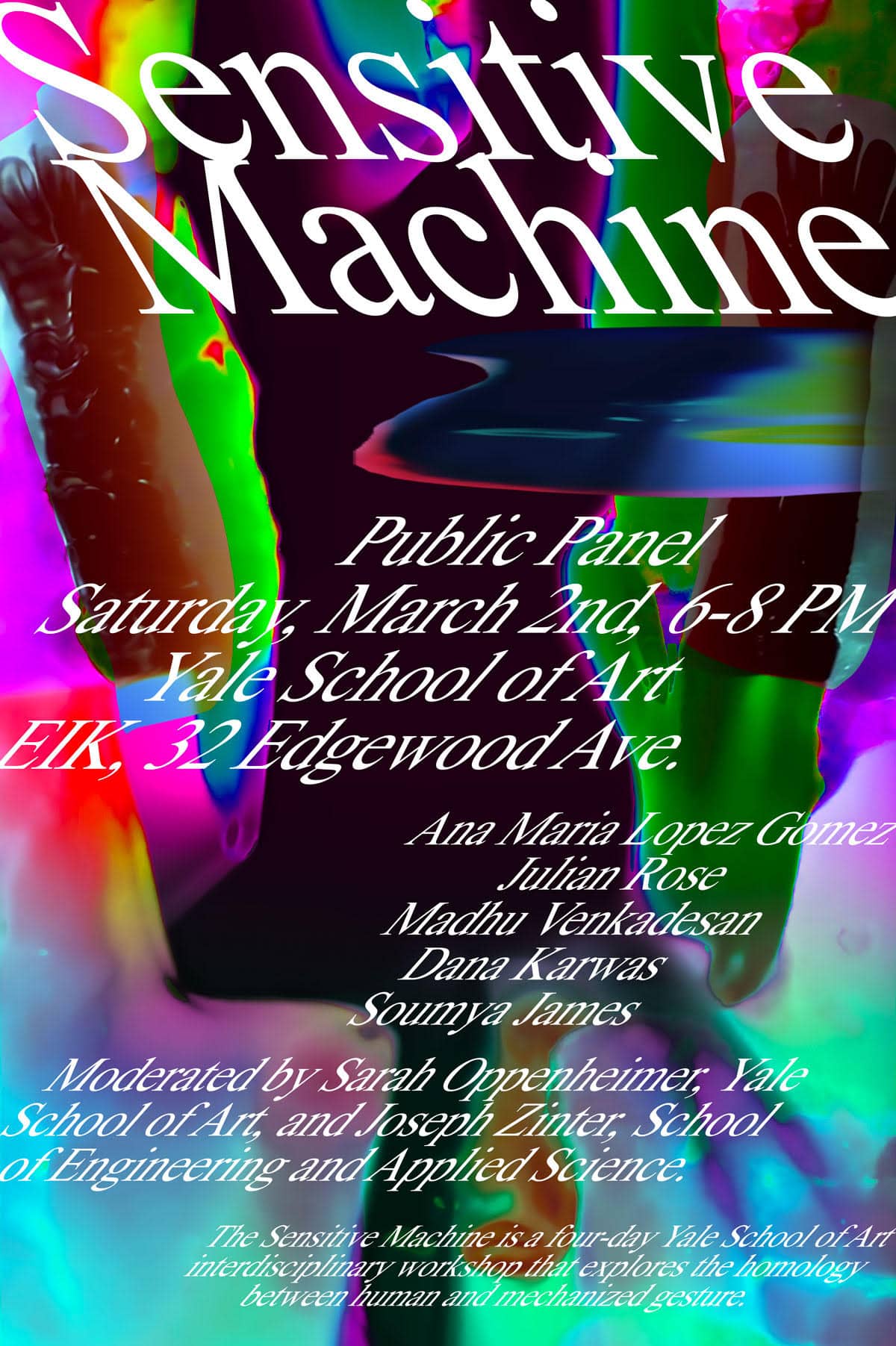
- The Sensitive Machine
- Saturday, March 2nd, 6-8 PM
- Yale School of Art
- EIK, 32 Edgewood Ave.
- Ana Maria Lopez Gomez
- Julian Rose
- Madhu Venkadesan
- Dana Karwas
- Soumya James
Moderated by Sarah Oppenheimer, Yale School of Art, and Joseph Zinter, School of Engineering and Applied Science.
The Sensitive Machine is a four-day Yale School of Art interdisciplinary workshop that explores the homology between human and mechanized gesture.
Spring 2019 Workshop
In his 1810 essay, On the Marionette Theater, Heinrich von Kleist proposes the marionette as a perfect simulation of human motion. The marionette’s dynamic equilibrium is achieved through a string suspension system.
The workshop begins with an investigation into bodily equilibrium: where is the body’s center of gravity? How does balance impact the body’s sense of position? A single gesture will be identified, isolated and analyzed. The motion will then be exaggerated by grafting the gesture onto a mechanical extension. For example, the rotation of the shoulder or bending of the spine will be amplified through the attachment of a handcrafted prosthesis. Participants will design and build these bodily extensions. Once designed, participants will then assess the apparatus’s performance as a sensory conduit, investigating how the machine transfers sensation to and from the proprioceptive body. Data describing the body’s mechanized motion will feedback into the examination of gesture. Working collaboratively, participants will redesign their bodily extensions, this time as a sensitive bridge between living selves.
Participants: Sam Shoemaker (Sculpture, MFA ’20), Sara Emsaki (Painting MFA ’20), Ethan Zisson (Engineering BS ’20), Elena Tilli (Architecture M.Arch ’19), Mengi Li (Engineering MS ’20), Zhiyan Huang (Drama BFA ’20), Carly Sheehan, Kristoffer Ala-Ketola, Hangoma Atiqullo, Kyla Arsaadjaja, Hyung cho, Gabrielle D’Angelo, Jacob Broussard, Kim Altomare, Simone Cutri, Dawn Kim, Rodrigo Lopez Gomez, Elizabeth Hibbard (Photography MFA ’20), Sara Abbaspour (Photography MFA ’20), Kern Samuel (Painting MFA ’20)
Syllabus
Friday, March 1
EIK, 32 Edgewood Ave.
Opening Lecture
EIK, 32 Edgewood Ave.
Exercise 1: Non-visual sensoria that pertains to proprioception
- – Balance studies
- – Blind Navigation
- – Sensory and sensitive systems
EIK, 32 Edgewood Ave.
Exercise 2: Introduction to Linkage software + Data Collection
- – Group living machines using rope + rigid bodies
- – End of day: Introduction to final performance parameters
Fall 2018 Sensitive Machine Workshop
In his 1810 essay, On the Marionette Theater, Heinrich von Kleist proposes the marionette as a perfect simulation of human motion. The marionette’s dynamic equilibrium is achieved through a string suspension system.
The workshop begins with an investigation into bodily equilibrium: where is the body’s center of gravity? How does balance impact the body’s sense of position? A single gesture will be identified, isolated and analyzed. The motion will then be exaggerated by grafting the gesture onto a mechanical extension. For example, the rotation of the shoulder or bending of the spine will be amplified through the attachment of a handcrafted prosthesis. Participants will design and build these bodily extensions. Once designed, participants will then assess the apparatus’s performance as a sensory conduit, investigating how the machine transfers sensation to and from the proprioceptive body. Data describing the body’s mechanized motion will feedback into the examination of gesture. Working collaboratively, participants will redesign their bodily extensions, this time as a sensitive bridge between living selves.
Participants: Evan Chang (Graphic Design MFA ’19), Nicki Cherry (Architecture M.Arch ’20), Simone Cutri (Graphic Design MFA ’19), Emma Gregoline (Graphic Design MFA ’19), Phoebe Helander (Painting MFA ’19), Petra Hjartardottir, Jeong Woo Kim (Graphic Design MFA ’20), Efrat Lipkin (Sculpture MFA ’20), Catalina Ouyang (Sculpture MFA ’19), Zack Robbins (Graphic Design MFA ’19), Leila Seyedzadeh (Painting MFA ’19), Soomin Shon (Graphic Design MFA ’19), Orysia Zabeida (Graphic Design MFA ’19), Suzanna Zak (Sculpture MFA ’20), Alex Zak (Sculpture MFA ’20), Yeqin Zhu (Chemistry BS ’20)
Schedule
Friday, November 9th
EIK, 32 Edgewood Ave.
Lecture on Proprioception
- – Stringing a Marionette
- – Digital puppets
- – Nauman
- – Lygia Clark
- – Eshkol
- – Modern Times
EIK, 32 Edgewood Ave.
Exercise 1: Break into groups of 2
- – Balance (Mach - others?)
- – Reach: Blind navigation (Lygia Clark)
- – Reach: Bodily and worldly measurement (Nauman)
Lunch
EIK, 32 Edgewood Ave.
Exercise 2. Linkage Software
- – Break into groups of 4-5 – Construction Planes, Dance Notation and Building a machine: Linkage Software
- Demo
- – Develop basic proficiency with software
- – Draw a linkage system that works like a piston
- – Draw a linkage system that works like a section of the body:
- – Rotation of the arm, gait, etc.
Break
EIK, 32 Edgewood Ave.
Exercise 3. Human machines
- – Group living machines using rope + rigid bodies
- – Shared enactment (each group will perform other groups actions)
- – Outline workflow for Saturday